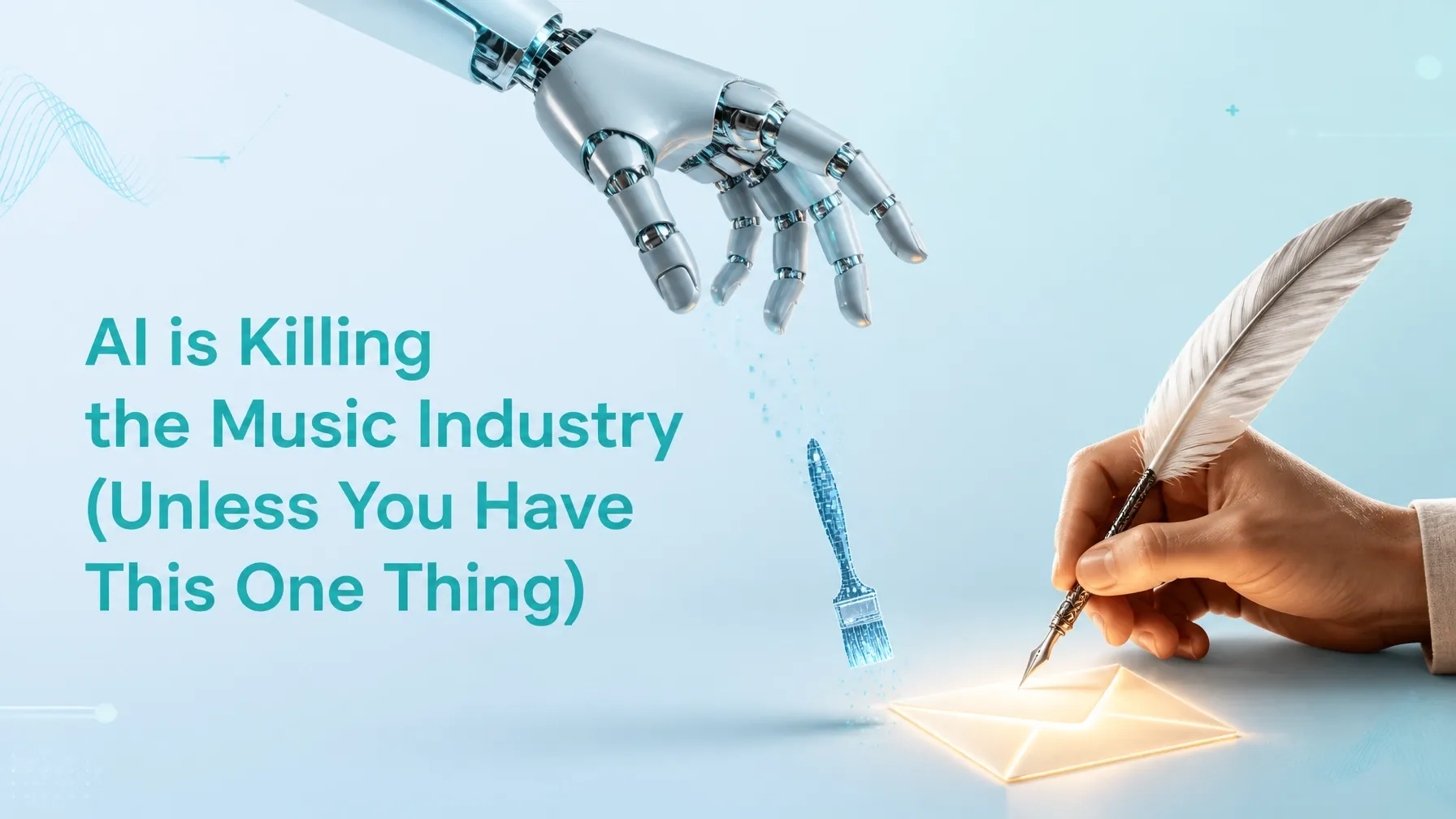
AI is Killing the Music Industry (Unless You Have This One Thing)
I’m just going to come out and say it: The rumors are 100% true.
Everyone is running around with their hair on fire, saying "AI is killing the music industry," and honestly? They aren't wrong! If you’re looking at the landscape of generic background tracks, royalty-free loops, and "vibey" elevator music, the robots have already won.
But here is the thing that nobody is telling you (and it’s the secret that keeps me up at night because I am a big dork about this stuff!): AI is only a threat if you don't have a fanbase.
**Let me start by saying: I’ve been an early adopter of AI tools like Midjourney. I use AI to help edit text I’ve already written and to generate images, tasks I would otherwise do myself and not what I consider my true art, which is music. I use Marblism because they don’t use my data to train their models, and they don’t financially support destructive political agendas. I also invest in initiatives that help counter the environmental impact of my AI usage.
This article is not about rejecting AI outright. It’s about why relying on AI to create music, especially if you are a professional or aspiring career musician, will not serve you in the long run. More importantly, it’s about how human creators can build careers and art that AI simply cannot replicate.**
If you are a career musician, a singer-songwriter, a composer, a performing artist, you are in a completely different league than a prompt engineer. But there’s a trap that a lot of talented people are falling into, and I want to make sure you aren't one of them.
Are you ready to find out how to stay bulletproof in the age of the algorithm? Let’s dive in!
The "Paint-by-Numbers" Problem: Why SUNO Isn’t Your Friend

Let’s talk about tools like SUNO for a second. Look, I get it. It’s fun! You type in "sad 90s grunge song about a cat," and boom, a song appears. It’s like magic!
But let’s be real: it’s paint-by-numbers.
Is it fun for hobbyists? Sure! It’s a blast to play with on a Sunday afternoon. But will you ever catch a real painter, someone who is deeply inspired to create art that changes lives, using a "color by number" kit and calling it their masterpiece? No way!
As a 2x GRAMMY-nominated musician, I’ve been in the trenches. I’ve done the DIY hustle, the late-night mixing sessions, and the deep-dive songwriting. I know that real art comes from a human nervous system. AI is a mirror; it can only reflect what’s already been done. It can’t feel heartbreak, and it certainly can’t share a meaningful connection with another human being.
If you’re building a career, you aren't just looking for "content." You’re looking for legacy.
The Legal Nightmare: You Can’t Own a Robot’s Homework
Here is the practical, non-dorky (okay, maybe a little dorky) truth about AI music: You don't own it.
If you make a track with an AI generator, you are running into a massive brick wall when it comes to business:
- Licensing is off the table: Most AI platforms have murky terms of service. If you don't have 100% clear human authorship, most sync libraries and labels won't touch it with a ten-foot pole.
- Streaming & Royalties: Building a legacy of performance royalties requires you to actually own the composition and the master recording. Under current US law, AI-generated content can't be copyrighted.
- Zero Equity: A catalog built primarily from uncopyrightable AI-generated material may have significantly less long-term ownership value. [Source: copyright.gov]
So yeah, for career musicians who want to make a living, AI-creation tools are a shiny distraction that leads to a dead end.
The Inevitability Lie: Just Because It’s Here Doesn’t Mean It’s Progress
There’s another trap hiding in this conversation, and I want to say it plainly: just because people keep repeating "AI is here to stay, use it or lose it" does NOT make it true, wise, or morally neutral.
History is full of systems people treated like they were permanent. Full of harmful, dehumanizing norms that the collective shrugged at and called "just the way things are." And thank God human beings kept pushing back anyway! Because "inevitable" has never been the same thing as "right."
That doesn’t mean every use of AI is evil. It does mean we should be very careful any time a technology asks us to surrender more humanity, more artistry, more agency, and then calls that "progress."
I’m not interested in bowing to a machine just because the loudest (or richest) people in the room say resistance is pointless. If something strips away the messy, meaningful, deeply human core of art, we are allowed to question it. We are allowed to reject it. Boldly!
So if you’ve been feeling gaslit by the whole "get on board or get left behind" narrative, let me lovingly remind you: you do not owe your humanity to a trend, even one that seems to be here forever.
The Antidote: One Email > Multiple Social Media Posts

So, how do you beat the robots? You build a relationship that a robot can't replicate. You build a fanbase.
I see so many musicians spinning their wheels on TikTok and Instagram, praying to the algorithm gods for a crumb of engagement. But did you know that one single email about your merch will make more sales than around nine social media posts?
It’s true! Social media is in decline. [Source: contentmation.com] Statistics show that email open rates for musicians usually hover between 20-30%, while organic social media reach is often stuck at a measly 5-10%. [Source: sona.com]
Your email list is the only platform you actually own. When you send an email, you aren't shouting into a digital void; you’re landing directly in the pocket of someone who already said, "I want more of YOU."
They are there for your stories, your process, and your art. They want to support you! Are you giving them the chance to do that, or are you just posting a Reel and hoping for the best?
Even if You Use AI... You STILL Need This

Now, I know there are a few of you reading this who are insisting on using AI to create music. Maybe you're using it to help with a drum loop or a basic arrangement. That’s fine!
Even if you go full-robot, an email list is your only hope for a real career. Social media is fleeting at best. Trends die, platforms change their rules, and accounts get shadowbanned.
If you want a sustainable, profitable music career, you need a system that doesn’t depend on social media behaving itself. That’s why I created Rock Your Email List. I’ve taught thousands of musicians how to stop yelling into the void online and start building real connection with the people already rooting for them. We cover the tech, the strategy, and how to write emails that sound like an actual human being.
And because I think musicians need this now more than ever, it’s currently 90% off with code ROCKEMAIL90.
How to Get Started (The Bite-Sized Version)
Feeling overwhelmed? Don't be! I am a master at breaking this stuff down into bite-sized pieces. If you want to move from uncertainty to profitability, here is your mini-roadmap:
- Claim Your Ground: Stop worrying about the "next big social platform" and start a simple email list today. Figure out the platform (I always suggest Kajabi as a place for all-in-one things like website, blog, podcast, membership, and of course, email list.)
- Focus on Ownership: Create music that YOU own. Use your human brain and your human heart. That is your USP (Unique Selling Proposition)!
- Follow a Framework: Don't guess what to do next. Use a proven path like Rock Your Email List to see exactly which of the five phases you're in.
AI might be changing the tools, but it isn't changing the human need for connection. You have something a machine will never have: soul.
Are you ready to stop being afraid of the robots and start building a career that lasts? Let’s make it happen! 🚀
Ready to take the next step in your music career?
- Free Framework: Not sure where you stand? Grab our Free Success Cycle mini-course to get clarity on your next steps and reduce the overwhelm!
- Long-Term Growth: Want monthly support and a community of like-minded creators? Join the Amplify Mastermind for long-term career success.
- Finally learn how to do email marketing the right way. Rock Your Email List is waiting for you with a massive discount with code ROCKEMAIL90.
